Empowering the Future: The Essential Web3 Development Tools for Decentralized Innovation
The evolution of the internet has brought us to a pivotal moment with the emergence of Web3, a decentralized and user-centric iteration of the digital world. Web3 promises enhanced privacy, security, and ownership of data, fundamentally transforming how we interact online. As developers and innovators embark on this new frontier, the tools they use are crucial to building and maintaining the decentralized web. This article delves into the essential Web3 development tools, highlighting their roles, benefits, and how they contribute to creating a more open and fair digital landscape.
Web3 is fundamentally about decentralization, removing the need for intermediaries and enabling peer-to-peer interactions. This paradigm shift demands a new set of tools and technologies. At the core of Web3 development are blockchain platforms like Ethereum, which provide the foundation for decentralized applications (dApps). Ethereum’s robust ecosystem, including smart contracts and decentralized finance (DeFi) protocols, has paved the way for other blockchains to innovate and offer unique features. For instance, Polkadot and Solana have emerged with solutions addressing scalability and interoperability, vital for the growth and sustainability of Web3 applications.
Smart contracts are self-executing contracts where the terms are directly written into code. They run on blockchain networks, ensuring transparency and security. Tools like Solidity, Ethereum’s primary programming language, enable developers to write and deploy smart contracts. Solidity’s syntax, similar to JavaScript, makes it accessible for those familiar with web development, thus bridging the gap between traditional and decentralized programming. Furthermore, frameworks like Truffle and Hardhat provide comprehensive development environments for smart contract development, including testing and deployment functionalities.
The rise of decentralized finance has underscored the importance of reliable and secure wallets for managing digital assets. Wallets such as MetaMask and Trust Wallet have become indispensable tools for Web3 users and developers. MetaMask, for instance, serves as a gateway to the Ethereum blockchain, allowing users to manage their assets, interact with dApps, and execute transactions seamlessly. For developers, MetaMask offers an API that facilitates integration with dApps, providing a seamless user experience. Trust Wallet, on the other hand, supports multiple blockchains, offering versatility and broader access to the Web3 ecosystem.
Decentralized storage solutions are another critical component of Web3 development. Traditional centralized storage poses risks of data breaches and censorship. Projects like IPFS (InterPlanetary File System) and Arweave offer decentralized alternatives. IPFS leverages a peer-to-peer network to store and share data in a distributed manner, ensuring content integrity and availability. Arweave takes a different approach with its “blockweave” technology, providing permanent and immutable storage, a feature particularly appealing for archival purposes and long-term data preservation.

In the realm of DePIN (Decentralized Physical Infrastructure Networks), projects like Helium and Filecoin illustrate how physical infrastructure can be decentralized. Helium uses a blockchain-based incentive model to create a decentralized wireless network, while Filecoin incentivizes users to rent out storage space, creating a decentralized data storage market. These projects demonstrate how Web3 principles can extend beyond digital realms into physical infrastructure, enhancing security, efficiency, and accessibility.
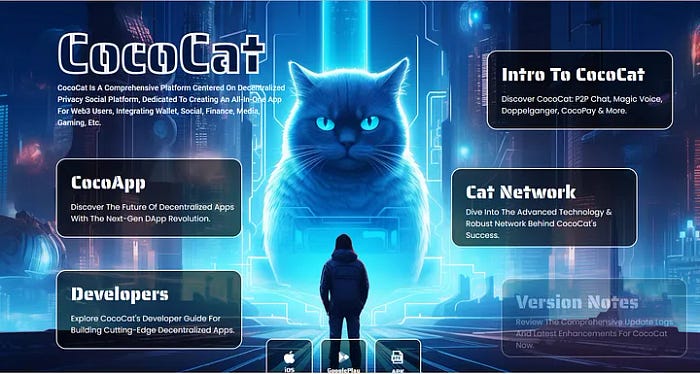
CocoCat is a prime example of how these principles are applied in practice. As a pioneering platform in the Web3 space, CocoCat integrates decentralized social networking with advanced encryption technologies. By leveraging DePIN concepts, CocoCat ensures that user data is not only secure but also user-controlled. This is achieved through decentralized servers and robust encryption protocols, providing a social networking experience free from central authority and surveillance. For developers, CocoCat offers a comprehensive toolkit for building on its platform, including APIs and SDKs designed to facilitate the creation of secure, user-centric applications.
The development of Web3 applications also relies heavily on decentralized identity solutions. Projects like ENS (Ethereum Name Service) and Sovrin provide frameworks for decentralized identities, enabling users to own and control their digital identities without relying on centralized authorities. ENS, for example, maps human-readable domain names to blockchain addresses, simplifying the user experience and promoting broader adoption of decentralized applications. Sovrin offers a more comprehensive solution with self-sovereign identities, allowing individuals to manage their credentials and prove their identity securely and privately.
The success of Web3 hinges not only on the technology but also on the community and ecosystem that support it. Platforms like GitHub and Gitcoin play a crucial role in fostering collaboration and funding open-source projects. GitHub remains the primary repository for most blockchain projects, facilitating code sharing and collaboration. Gitcoin, however, goes a step further by providing a platform for developers to earn rewards for contributing to open-source projects, thereby incentivizing innovation and community participation.
In conclusion, the Web3 ecosystem is rich with tools and platforms that empower developers to build decentralized applications that are secure, efficient, and user-centric. From blockchain platforms and smart contract frameworks to decentralized storage solutions and identity protocols, these tools are the building blocks of a new digital era. As Web3 continues to evolve, the collaboration between developers, users, and platforms like CocoCat will be essential in realizing the full potential of a decentralized web. The journey towards Web3 is not just about technology but about creating a more open, equitable, and resilient internet for everyone.


Comments
Post a Comment